Our school districts are poor and receive low standardized test scores. Our high school's students for the most part have jobs and ride the bus to school. Parents all are working class, lawns are often left not mowed, and some cars never leave the curb, tires flatter than the cracked sidewalks and driveways.
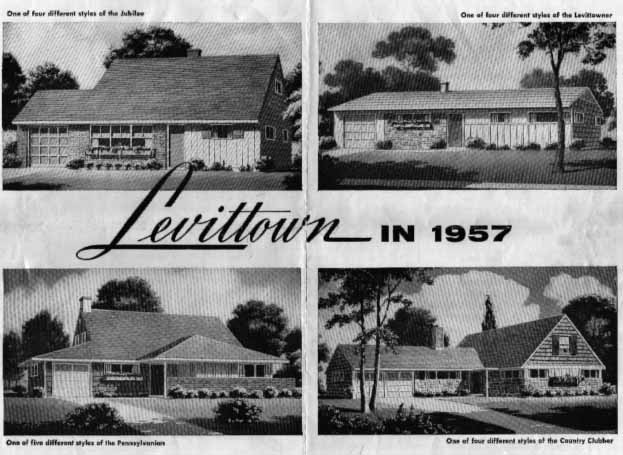
Some of the elderly couples that live in Levittown can remember when the town began in 1951 and William Levitt built those four home models; Rancher, Jubilee, Pennsylvanian and obviously, the Levittowner.
Know that song that goes...
"There's a green one and a pink one
And a blue one and a yellow one
And they're all made out of ticky tacky
And they all look just the same."
I studied Pete Seeger in Spanish III senior year. I always believed it was because of his activism concerning the Spanish Civil War, but oh how naive was I?
 |
| Photo courtesy of capitalcentury.com |
My grandmother grew up in a section (us Levittowners call our neighborhoods sections, as they all have titles and each street name begins with the same letter as its title,) called Violetwood. She lived with her parents, older sister and younger brother in a rancher, as I recall. Her parents moved from Philly and my grandma started school at Ralph Waldo Emerson Elementary, a few streets away from her house.
William Levitt engineered the town so that no child would have to cross major roads on the walk to school. Today, parents are fearful of letting their child walk down the street alone, let alone a mile to school. Levittown is no slum or ghetto by any standards, but it is now a place with some shady characters and unfriendly neighbors. No one is personable anymore.
There were public pools then in many of the sections. There was a sense of community.
My grandmom moved out of the town, first up to Langhorne, then slightly farther north to Newtown where my mother was raised. They had money; Newtown is an affluent community in Bucks County with rich history involving the revolutionary war.
It was only fate that my mom would marry my Philadelphian father and move their new family into Indiancreek. Our house cost $80,000 in 1993. There were public swimming pools still, though some families had privet pools in their backyards. We skated at "Rollerama," an indoor roller rink. We went to school in the same buildings as our grandparents.
 |
| Photo Courtesy of Flickr.com |
We sold our house in 2008 for $140,000. The public pools closed when I began kindergarten. Rollerama closed and it's a sin that I can't even remember when. There's a Giant food store in its place today. They're closing down five of the nine elementary schools in my Alma mater's district and condensing them into three super schools built on the sites of the remaining schools. Clara Barton, my very own, will remain as the administrative building; my grandma's former school will be gone forever.
I'm glad I was raised there; I learned the value of a buck, that my life could be worse, and that crying gets you no where in public school... or the real world.
I rode my bike everywhere (my mom was far from overprotective, my dad raised us to be "tough.") We came home when the streetlights were on and were grounded if we were late or forgot to take out the trash. We did chores to earn money for the movie theaters that we'd have to save up for months to go see.
We saw examples of who not to grow up to be like. Today there are 123 listings for halfway houses in the area. Marijuana is a problem; heroine is becoming a bigger problem.
My grandmother learned a different lesson growing up in Levittown. She lived down the road from a farm, and recalled when my nan sent her and my great-aunt Joyce to pick up eggs.
 |
| My childhood home, as I remember it in my teenage years. |
My grandmother doesn't tell many stories of her youth, but I can tell why this one sticks with her and also with me.
She remembered my nan gave her about 50 cents. She walked up to the farm, holding a basket for her mothers eggs, and much to her and my great-aunt's dismay, saw chickens freshly beheaded. The problem, however, was not that they were bloodied or headless, it was that the decapitated creatures were running around.
As you can tell by my shock to the phenomena, our suburbia has vastly urbanized.
Levittown was a place of prosperity. President John F. Kennedy spoke at a Levittown shopping center, of all places, in 1960.
It had its problems, too. There was a strict "no blacks" policy in the fifties that eventually became the subject of lawsuits and collapsed.
Today's world is becoming more equal in someways, but the class divide is as visible as ever. Levittown is a prime example of the gap in wealth, but that hard work can accomplish great things in these trying times.


